Blower door test
BLOWER DOOR TEST
The Blower Door Test is a measurement method that verifies the level of tightness of a certain building, calculating the pressure difference. Using this test, it is possible to discover the “air leaks” of the building envelope and evaluate the flow (or rate) of air exchange.
This procedure is therefore, a very useful air tightness test to check and eliminate air leaks and drafts inside a building. As a result, it is possible to reach a higher level of thermal insulation and in turn, significant energy savings.
This method is particularly beneficial in detecting any pre-existing defects at the construction site.
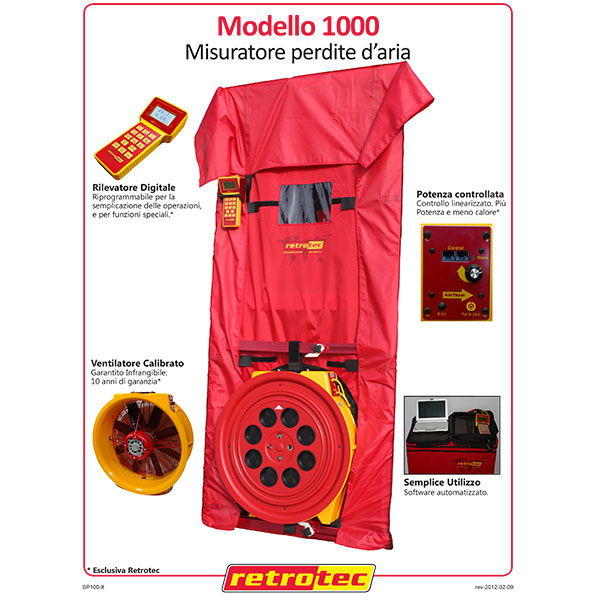
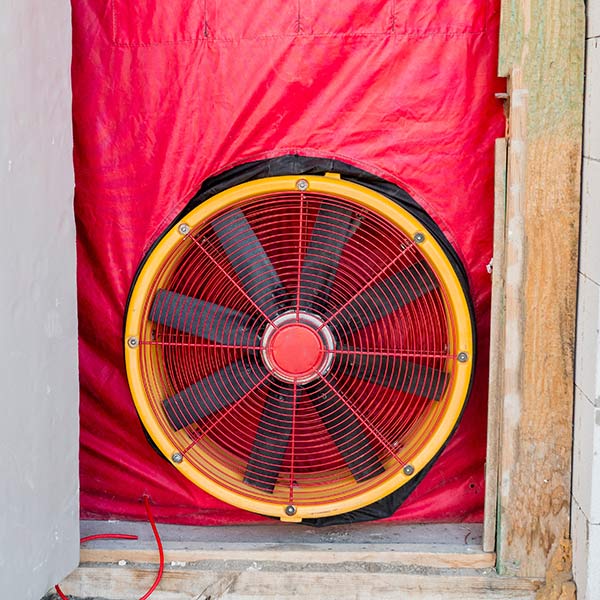
The Blower Door Test is carried out using a special fan. Air is fed into or sucked out of the building during the same measurement process. The fan force is adjusted so that there is a difference of 50 Pa (Pascal) with respect to the ambient pressure.
The pressure difference between two points in the atmosphere is the one that generates the wind. For example, with a wind intensity of 5 there is a pressure difference of about 50 Pa.
Next, the fan is recessed into a frame that is applied to the front door, hence its name: the Blower Door Test. Instruments are connected to the fan to measure the pressure difference and the intensity of the air flow.
At the same time, the rotation speed of the fan is adjusted in such a way as to generate a well defined pressure difference between the inside and the outside. As a result, an air flow is induced equal to that due to the “leaks” of the building (due to the depression). Finally, the measured air flow is divided by the volume of the building.
The exact measurement procedure is regulated by UNI EN 13829: “Thermal performance of buildings – Determination of air permeability of buildings – Pressurization method by fan”.